




 Click it and Unblock the Notifications


Latest Updates
-
 Horoscope for Today May 21, 2026 - Curiosity Rises, Plans Shift
 -
 Paneer Lababdar Recipe: Creamy Restaurant-Style Curry Made Easy
 -
 Mouni Roy’s Cannes 2026 Patola Gown Took 300 Hours To Craft — The Story Of Gujarat’s GI-Tagged Weave
 -
 Bread Pizza Recipe: Your Instant Snack Hack
 -
 India's Hottest City Hit 47.6°C Today — This Is What Heatstroke Looks Like
 -
 Exclusive: Rubina Dilaik Said Yes To The Ward In Seconds: Here's The Raw Truth Behind Why
 -
 PM Modi Turns Viral ‘Melodi’ Nickname Real With Melody Gift To Meloni, Inside India’s Iconic Toffee Origin
 -
 Superglue, A Potato, A Plastic Bag: The Dangerous DIY Contraception Cases That Shocked Doctors
 -
 One Pot Easy Meal: Delicious Veg Pulav Recipe
 -
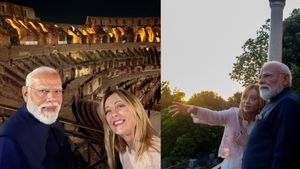 'Melodi' Moment Breaks The Internet: PM Modi Meets Giorgia Meloni In Rome, Colosseum Diplomacy Explained


From Theory to Practice-Part III


There is, however, no substitute to practice.
Swamiji held that the aim of religion is to manifest the inherent divinity by controlling our twofold nature (external and internal). Controlling means practising, making efforts, striving hard to let the inner light express itself in our life. This requires practice. Practice has one more meaning: repetition. A musician, for instance, practises the same melody or composition several times before he masters it. So also in spiritual life, same practices are done over again to obtain the promised results. In the realm of perfection, no dabbling is permitted. Be it playing football or playing piano or doing one's spiritual practices, one has to work hard. A mere curious hands-on experience would be of no avail.
Once after a particularly brilliant concert, Beethoven, the great Western classical musician, was in the centre of congratulating friends and admirers who praised his piano magic. One unusually enthusiastic woman exclaimed: 'Oh, sir, if only God had given me this gift of your genius.' 'It is not genius, madam,' replied Beethoven, 'Nor magic. All you have to do is to practise on your piano eight hours a day for forty years and you will be as good as I am.' Similarly, Sri Ramakrishna was once taken to a circus, where he saw an English woman's feat on a running horse. He later said, 'The other day, at the circus, I saw a horse running at top speed, with an English woman standing on one foot on its back. How much she must have practised to acquire that skill!' (Gospel of Sri Ramakrishna, p. 182)
Spiritual practices loosen our inner fetters. It is like the patient chiselling of a piece of stone by a sculptor. Unmindful of rest, food and sleep, he goes on hitting at the same spot, again and again, until the image of God hidden in the stone emerges out. All spiritual giants the world has seen had only one purpose for their advent—how to make religion more practicable. They do so not just through their teachings but by living what they preach.
Practice also has an eternal companion—dispassion. Practice has to be accompanied by dispassion. Together these twin companions bring success in spiritual life. Practice means doing and dispassion means clearing the obstacles. Practice when not accompanied by dispassion become ineffective, like rowing an anchored boat. Joined with dispassion, practice takes ahead the aspirants with speed, safety and surety.
Spiritual practice means practising those techniques and following such a life-style as would lead to the purification of mind. Mind becomes pure through practice. One has to practise meditation, practise prayer, practise self-control, practise moral discipline—in short, practice is the secret of success.
To sum up, practising spiritual disciplines is what makes us religious—not mere intellectual acceptance of a dogma. We would be nearer to God only through practice, and not by mere talking about it. We have to get rid of the false notion of setting 'others' right, calm down the mind, be willing to pay the price for what we want, and overcome our laziness and complacency, in order to carry on spiritual disciplines.
What is required is a pure mind, fit for spiritual realization and that is what religion should aim at. For, as Swamiji said, 'one man who has purified himself thoroughly accomplishes more than a regiment of preachers.' Ultimately the choice is ours—to be mere preachers or practitioners
About the author
Swami Atmashraddananda
Swami Atmashraddhananda is a monk of the Ramakrishna Order and editor of The Vedanta Kesari from the year 2004 .
Chat With The Devotees Of Ramakrishna Paramahamsa

 Continue with Google