




 Click it and Unblock the Notifications


Latest Updates
-
 Horoscope for Today May 21, 2026 - Curiosity Rises, Plans Shift
 -
 Paneer Lababdar Recipe: Creamy Restaurant-Style Curry Made Easy
 -
 Mouni Roy’s Cannes 2026 Patola Gown Took 300 Hours To Craft — The Story Of Gujarat’s GI-Tagged Weave
 -
 Bread Pizza Recipe: Your Instant Snack Hack
 -
 India's Hottest City Hit 47.6°C Today — This Is What Heatstroke Looks Like
 -
 Exclusive: Rubina Dilaik Said Yes To The Ward In Seconds: Here's The Raw Truth Behind Why
 -
 PM Modi Turns Viral ‘Melodi’ Nickname Real With Melody Gift To Meloni, Inside India’s Iconic Toffee Origin
 -
 Superglue, A Potato, A Plastic Bag: The Dangerous DIY Contraception Cases That Shocked Doctors
 -
 One Pot Easy Meal: Delicious Veg Pulav Recipe
 -
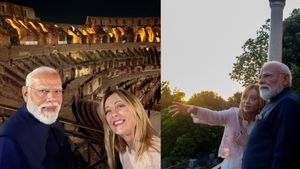 'Melodi' Moment Breaks The Internet: PM Modi Meets Giorgia Meloni In Rome, Colosseum Diplomacy Explained


No One Bathes In The Same River Twice-Part II


Ordinarily one takes the mind to be a permanent and separate entity like one's body. Ramana begins by pointing out that because there are thoughts we assume that there is a mind from which they emanate. Ramana asks, "Take away thoughts, then where is the mind?" This statement is only to point out the truth that when every thought is changing and is different and is in fast motion there must be a common or linking centre which alone can be called the mind.
Ramana's solution is alert watchfulness of thought at its moment of birth. For, such attention would put an immediate stop not only to that thought but also to the proliferation of that thought into hundreds of related thoughts. This practice of paying attention to the Self, called self-enquiry begins by focussing attention on the subject 'I' and by not allowing any distraction which would happen whenever there is slackening of attention to the rising thought.
Attention to rising thoughts would allow the movement of thoughts from one moment to another without being clogged. As a result the mind would be spacious. This freedom would be a growing freedom. It arises from steadfast practice that is a result of detachment from nagging and obsessive thoughts.
Thought will arise and subside naturally depending exclusively on the need of that moment. This dropping of the thought load by diligent and persistent practice of Self-attention would open up a whole new world hitherto unknown to us. It is like the relief enjoyed by a labourer carrying a heavy load when he drops that load at the destination. The mind which is now fragmented and enervated, would be alert, attentive, powerful and unitary. For the mind is consciousness and is of the same nature as the Self.
In this context one can appreciate the repeated assertion of Ramana that the nature of the mind is pure like ether and its power is the power of the Self. The individual and separate subject, separate 'I' will cease to exist naturally when its associations with experiential thoughts are cut and it exposes itself to the magnetic force of the Self.
In understanding the true nature of one's own mind, one would have discovered one's own immortality by freeing oneself from the shackling thoughts. For the sake of communication and understanding one might say that the mind which we now know would cease to be and be replaced by the pure, unitary mind enabling one to be in the state of natural happiness.
Chat With The Devotees Of Bhagwan Ramana Maharishi

 Continue with Google