




 Click it and Unblock the Notifications


Latest Updates
-
 Exclusive: Rubina Dilaik Said Yes To The Ward In Seconds: Here's The Raw Truth Behind Why
 -
 PM Modi Turns Viral ‘Melodi’ Nickname Real With Melody Gift To Meloni, Inside India’s Iconic Toffee Origin
 -
 Superglue, A Potato, A Plastic Bag: The Dangerous DIY Contraception Cases That Shocked Doctors
 -
 One Pot Easy Meal: Delicious Veg Pulav Recipe
 -
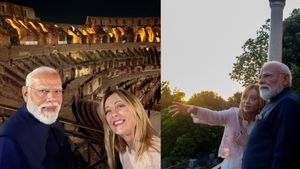 'Melodi' Moment Breaks The Internet: PM Modi Meets Giorgia Meloni In Rome, Colosseum Diplomacy Explained
 -
 Remembering Bipin Chandra Pal On His 94th Death Anniversary With 10 Bold Quotes On Swaraj And Identity
 -
 'That Imposter Syndrome Is Always There' — Virat Kohli Just Said What Most High Achievers Won't Admit
 -
 Varada Chaturthi 2026: Significance, Puja Timings, Rituals And Why Devotees Avoid Seeing The Moon
 -
 Is Your Mango Safe To Eat? Seven Warning Signs To Check Before You Bite
 -
 Your Quick Energy Drink: The Ultimate Banana Shake Recipe


Indian Builds Rome In A Day!


The new program can digitise hundreds of pictures of the city, including the Colosseum and St. Peter's Basilica, in just a matter of hours. It uses hundreds of thousands of tourist photos to automatically reconstruct an entire city in about a day.
Developed by Sameer Agarwal of the University of Washington built a fully digital Rome using 1,50,000 tourist photos, tagged with the word "Rome" or "Roma" that were downloaded from the popular photo-sharing Web site, Flickr.
Computers analysed each image, combined them in 21 hours, and created a 3-D digital model. "How to match these massive collections of images to each other was a challenge," said Sameer Agarwal, a UW acting assistant professor of computer science and engineering, and lead author of a paper being presented in October at the International Conference on Computer Vision in Kyoto, Japan.
He said: "(Until now) even if we had all the hardware we could get our hands on and then some, a reconstruction using this many photos would take forever."
In addition to Rome, the researchers have recreated the Croatian coastal city of Dubrovnik, processing 60,000 images in less than 23 hours using a cluster of 350 computers, and Venice, Italy, processing 250,000 images in 65 hours using a cluster of 500 computers.
The novel technique can create online maps that offer viewers a virtual-reality experience.
AGENCIES

 Continue with Google