




 Click it and Unblock the Notifications


Latest Updates
-
 Horoscope for Today April 06, 2026 - Practical Steps Bring Calm Progress
 -
 Chana Masala Recipe: Experience Dhaba Style Authentic Taste
 -
 Struggling With Oily Skin This Summer? Simple Tips to Keep Shine Under Control
 -
 Garlic Bread Recipe: The Cheesy Bakery Style Trick You Need
 -
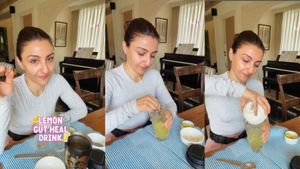 Soha Ali Khan Swears By This ‘Gentle Game-Changer’ Lemon Drink for Gut Health: Full Recipe Inside
 -
 World Health Day 2026: You’re Not As Healthy As You Think—Here’s Why
 -
 One Pot Easy Lunch Recipe: Flavorful Veg Pulao
 -
 Karan Aujla India Tour Controversy: Lucknow and Ludhiana Shows Cancelled—What Went Wrong?
 -
 Kissing Disease Linked to 3x Higher Risk of Multiple Sclerosis: What You Should Know
 -
 Feeling Drained in the Heat? 10 Healthy Drinks to Sip This Summer


Google Marks Indian Cell Biologist Kamal Ranadive's 104th Birthday With Doodle

Google on Monday celebrated Indian cell biologist and cancer research pioneer Dr Kamal Ranadive's 104th birthday with a Doodle. The illustration was made by India-based guest artist Ibrahim Rayintakath.

Ranadive is best known for her groundbreaking cancer research and devotion to creating a more equitable society through science and education.
"Happy birthday, Dr Kamal Ranadive!" the Google Doodle page said.
Kamal Samarath, better known as Kamal Ranadive, was born on this day in 1917 in Pune. Her father's encouragement to pursue a medical education inspired Ranadive to excel academically, but she found her calling in biology instead.
In 1949, she received a doctorate in cytology, the study of cells, while working as a researcher in the Indian Cancer Research Center (ICRC). After a fellowship at Johns Hopkins University in Baltimore, Maryland, US, she returned to Mumbai and the ICRC, where she established the country's first tissue culture laboratory.
"As the director of the ICRC and a pioneer in animal modelling of cancer development, Ranadive was among the first researchers in India to propose a link between breast cancer and heredity and to identify the links among cancers and certain viruses," Google wrote in a bio accompanying the Doodle.
Continuing this trailblazing work, Ranadive studied Mycobacterium leprae, the bacterium that causes leprosy, and aided in developing a vaccine.
In 1973, Ranadive and 11 colleagues founded the Indian Women Scientists' Association (IWSA) to support women in scientific fields.
"Ranadive fervently encouraged students and Indian scholars abroad to return to India and put their knowledge to work for their communities," Google said.
After retiring in 1989, Ranadive worked in rural communities in Maharashtra, training women as healthcare workers and providing health and nutrition education.
The IWSA now has 11 chapters in India and provides scholarships and childcare options for women in science. Ranadive's dedication to health justice and education remains influential to her students who work as scientists today.
Source: IANS
Disclaimer: The information provided in this article is for general informational and educational purposes only and is not intended as a substitute for professional medical advice, diagnosis, or treatment. Always seek the advice of your physician or a qualified healthcare provider with any questions you may have regarding a medical condition.


 Continue with Google